












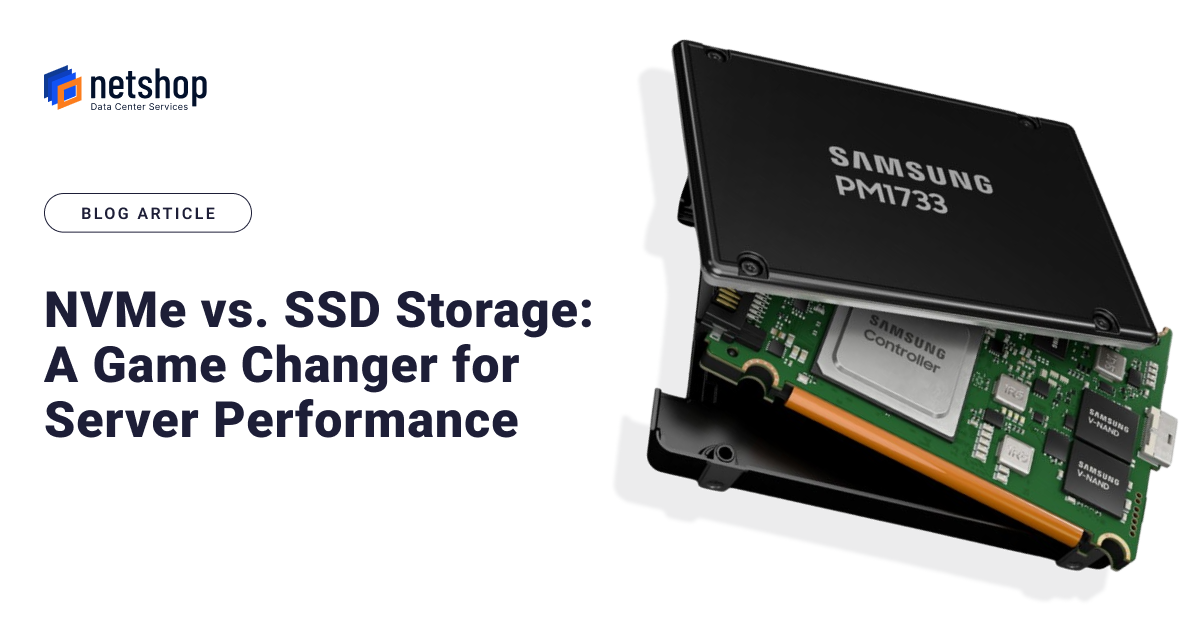

When it comes to server performance, storage solutions play a critical role in determining speed, efficiency, and reliability. As technology advances, storage options have evolved, and one of the latest innovations is NVMe (Non-Volatile Memory Express) storage. Unlike traditional SSDs (Solid State Drives), NVMe storage offers significantly improved performance, making it an ideal solution for businesses that rely on fast, efficient data processing and retrieval.
In this article, we’ll explore why NVMe is a far better storage solution compared to SSDs, highlighting the key differences and the industries that benefit most from this advanced technology.
Understanding the Basics: SSD vs. NVMe
Before diving into the advantages of NVMe, it’s essential to understand the difference between SSD and NVMe. SSDs have replaced hard disk drives (HDDs) in many servers because of their faster read/write speeds and reliability. Traditional SSDs use the SATA (Serial ATA) interface, which is limited by the bandwidth of that connection.
On the other hand, NVMe is a newer interface specifically designed for modern flash memory. It uses the PCIe (Peripheral Component Interconnect Express) interface, which provides a direct connection between the storage and the CPU. This means that NVMe drives can handle significantly more data at much faster speeds compared to SSDs. In fact, NVMe storage can be up to 6 times faster than SATA-based SSDs, with lower latency and improved power efficiency.
For dedicated server environments where speed and data throughput are critical, such as web hosting or running virtual private servers (VPS), NVMe is an essential upgrade.
Main Differences of NVMe SSD vs Traditional SSD (SATA)
| Feature | NVMe SSD | Traditional SSD (SATA) |
|---|---|---|
| Interface | PCIe (direct to CPU) | SATA III |
| Protocol | NVMe | AHCI |
| Maximum Theoretical Bandwidth | Up to ~7,000+ MB/s (PCIe 4.0 x4) | ~600 MB/s |
| Latency | Very low (microseconds) | Higher (still low vs. HDD, but limited by AHCI) |
| Parallelism (I/O Queues) | Up to 64,000 queues, 64,000 commands each | 1 queue, 32 commands |
| Typical Random IOPS | 500,000+ (although most NVMe brands offer up to 1 Mil. IOPS) | ~90,000–100,000 |
| Form Factor | M.2, U.2, U.3, PCIe add-in card | 2.5″ drive, M2 |
| Cost (per GB) | Higher | Lower |
| Power Efficiency | Higher performance-per-watt, but higher peak draw | Lower peak power draw |
Key Advantages of NVMe Storage Over SSDs
1. Unmatched Speed and Performance
NVMe drives have a clear advantage over SSDs in terms of speed. Thanks to the PCIe interface, NVMe drives can achieve read/write speeds of up to 3,500 MB/s, compared to around 550 MB/s for a standard SATA-based SSD. This increase in speed is crucial for tasks that require rapid data access and processing, such as database management, high-traffic websites, and cloud computing applications.
NVMe drives are also capable of handling multiple requests simultaneously due to their superior IOPS (Input/Output Operations Per Second) performance. This means faster data processing, which translates to quicker load times for applications, enhanced multitasking, and an overall improved user experience.
2. Lower Latency
Another critical factor is latency, which refers to the delay in processing requests for data. With traditional SSDs, data has to travel through several stages before it reaches the CPU, leading to higher latency.
NVMe reduces these stages, resulting in minimal delay and more efficient data handling. Lower latency is especially beneficial for time-sensitive applications, such as forex trading platforms or gaming servers, where even a slight delay can negatively affect performance.
3. Enhanced Power Efficiency
NVMe drives are not only faster but also more power-efficient than their SSD counterparts. They consume less power per I/O operation, meaning that businesses can expect lower energy costs while enjoying faster data processing. This is particularly valuable for large-scale data centers or servers handling high volumes of traffic where efficiency and cost savings are paramount.
4. Scalable for Modern Applications
As businesses continue to evolve and grow, their storage needs also change. NVMe drives are built to scale with modern applications, making them a perfect fit for industries that require high-speed data access and large-scale storage solutions.
Whether it’s cloud computing, artificial intelligence (AI), or big data analytics, NVMe storage can keep up with the increasing demands of these high-performance environments.
5. Future-Proof Technology
SSDs were once seen as the gold standard for storage solutions, but with the advent of NVMe, the future is clear. As more software and hardware are optimized for NVMe’s superior speed and performance, businesses that adopt this technology will find themselves better positioned for the future of digital infrastructure.
Industries That Benefit the Most from NVMe Storage
With its superior speed, low latency, and high throughput, NVMe storage is ideal for a wide range of industries that rely on server performance to succeed. Here are the top five industries that benefit the most from NVMe storage:
1. Forex Trading: In the fast-paced world of forex trading, milliseconds matter. Traders need access to real-time data and lightning-fast execution of trades. NVMe storage’s low latency and high throughput allow FX trading platforms (such as MetaTrader MT5) to process large volumes of data quickly, giving Forex brokers an edge in this competitive environment. Additionally, NVMe-powered VPS servers are becoming the most popular option among forex traders who seek an uninterrupted, fast-performing hosting environment for their automated trading strategies.
2. Online Gambling and Gaming: Gaming and online gambling servers host millions of players and transactions every day. Any latency or downtime can result in a loss of users and revenue. NVMe storage ensures that gaming servers can process multiple user requests simultaneously with minimal delay, providing a seamless and enjoyable experience for users. Learn more about hosting solutions for online gaming in our dedicated servers section.
3. E-Commerce: Online retail platforms need to provide a smooth, responsive experience for customers, especially during peak traffic times like Black Friday or Cyber Monday. Slow website load times or payment delays can cost e-commerce businesses millions. With NVMe storage, online stores can handle large amounts of traffic, transactions, and database requests with ease.
4. AI: AI workloads are fundamentally data-hungry, and storage speed directly impacts training and inference efficiency. Large language models and deep learning pipelines require rapid access to massive datasets — often terabytes of images, text, or sensor data — during training, and NVMe’s high throughput and low latency eliminate storage as a bottleneck, keeping GPUs fed and reducing idle compute time.
5. Cloud Service Providers: Cloud service providers need to offer fast, reliable storage for a wide range of clients, from small businesses to enterprise-level corporations. NVMe’s scalability and efficiency make it an ideal solution for cloud infrastructure, allowing providers to deliver faster services with reduced operational costs.
NVMe-powered Servers; a clear choice for the future of Hosting
NVMe storage offers a significant upgrade over traditional SSDs, providing faster speeds, lower latency, better power efficiency, and scalability for modern applications. For businesses that rely on high-performance servers, whether for forex trading, online gambling, or cloud services, NVMe is a game changer.
As a hosting provider, NetShop ISP understands the critical importance of delivering top-tier performance to our customers. That’s why we’ve recently integrated NVMe storage into our dedicated and virtual private servers.
To learn more about how NVMe storage can improve your server performance, contact our customer service representatives to retrieve more information or get a quote for an NVMe-powered server tailored to your specific needs.